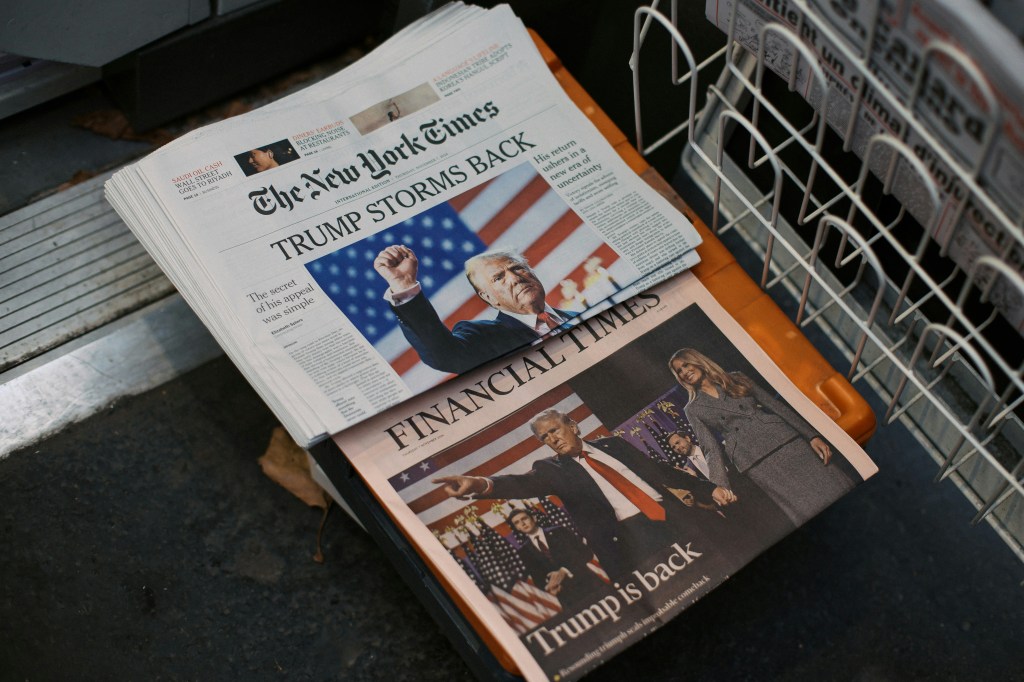
Throughout the nearly 100 days that Donald Trump has spent in office, his social media presence has not ceased once
Few have used social media in a campaign the way Trump has. And even fewer have recruited a social media mogul to take a position in office.
Though the pair began on rocky terms, Trump’s welcoming back onto X (formerly known as Twitter) appeared to build a bridge. Musk gradually aligned closer with Trump’s policies, and now finds himself in the role of Senior Advisor to the President for the Department of Government Efficiency (DOGE).
As the world watches on, political scientists try to decipher and plot Trump’s next moves, but weekly, paradigm-shifting events are make this very difficult.
Professor Jason Gainous has research interests in Digital Political Communication. American-born, he now works at the University of Sharjah in the UAE, and co-authored ‘Tweeting to power: The social media revolution in American politics’.
Over a decade on from the publishing of the paper, Gainous has seen the expansion of social media in American politics, and believes it will only continue but with worrying consequences.
The mood during our conversation on 7th February was one of trepidation; even the most wised-up of commentators could not have predicted Trump’s plans for tariffs and his executive orders, which have covered everything from showerhead pressure to the TikTok ban. However, Gainous did have some suspicions that have recently started to materialise.
Trump’s X domination
Gainous began speaking about Trump’s reintroduction on X. Initially, the president used his platform, Truth Social, but came back to X after a referendum set up by Musk on 22nd November 2022. Upon the result, in which 51.8% of respondents voted for Trump’s return, Musk tweeted, “The people have spoken. Trump will be reinstated. Vox Populi, Vox Dei.”
Yet Trump did not follow the social media playbook in the way that other politicians have. While they posted press releases and pictures from events which make them look favourable, Trump’s methods have been far less orthodox.
Gainous says: “Trump comes along and he just says anything, contradicts himself, doesn’t worry about grammar. He always had this motto which is ‘there is no such thing as bad press’ and so what he was able to do initially before Twitter turned to X was just dominate the agenda.”
According to Gainous, Trump’s tactics were to be as inflammatory as possible, in an effort to have all of the media spotlight on him. The right-wing press would praise his attacks on liberals and their policies, and the left would demonise him and call for his head. Whatever opinion the coverage took, it was still coverage.
It goes deeper, with Trump attempting to siphon off enough people who trust neither aspects of the coverage, to look to him as a beacon of truth in an environment of lies.
Trump’s strategy of being chaotic and boisterous on social media was facilitated by Musk’s changes to X’s algorithms. Overnight, users began seeing what everyone else was paying attention to, so when Trump would make an outrageous claim about someone and users stopped scrolling to read it, it would appear on your timeline, too.
“The first thing I saw was violence and fights, not political violence but people fighting outside a pub, and another thing I noticed was what in the US what we call rubbernecking, which is when there’s an accident and you slow down and look.”
Prof Jason Gainous
Trump’s defiance of the political status quo has acted as a source of excitement and refreshment for his supporters, but a source of disgust and alarm for his haters, which, in turn, spurs on his supporters further.
One of the most inexplicable things to come out of Trump’s second success in the bid for the presidency has been the level of Elon Musk’s involvement in proceedings. Musk first joined Trump’s team in December 2016, but he now appears to hold more of a senior position in the executive branch.
On Musk, Gainous pointed out that the SpaceX owner has autism, which can be a catalyst for innovation and creativity, but that those with neurodivergent minds can also be liable for traits of being unempathetic and narcissistic.
The Elon factor
Gainous says: “They are both, in certain ways, tremendous creatives in that they take different approaches in how they engage with people, the issue is I don’t think they understand the complexities of collective behaviour and how their actions will shape culture in 15 years because they’re both profit guys.”
The DOGE’s role is to cut government spending right down to its core, but the changes have been nothing short of wholesale. DEIA (diversity, equality, inclusion, and accessibility) programmes, the Department for Education, and the United States Agency for International Development have all faced drastic cuts, according to Fox.
All of the DOGE’s cuts have been listed on their website for transparency, and at the time of its conception, Musk said, via X: “We will have a leader board for the most insanely dumb spending of your tax dollars. This will be both extremely tragic and extremely entertaining.”
Gainous referred to Trump and Musk as circus showmen, playing up to the audience and keeping them coming back for more. They are doing this through their monumental decisions in personnel change, such as the removal of Joint Chief of Staff, General Mark Milley, and Democratic Federal Elections Committee (FEC) chair Ellen Weintraub, who believes her dismissal was illegal.
Musk’s Nazi-esque salute at Trump’s inauguration speech was also an effort to garner the shock factor, Gainous believes. He did admit that this cannot be taken as conclusive evidence that Musk holds Nazi ideals, but his claim that it was a Roman salute was just an excuse.
Amid all the chaos, Gainous sensed that major issues could arise from Trump’s turbulent style of governing, though he did hold out some hope that a method to the madness may appear in the future.
“Unless all of the top thinking economists and professionals are wrong, we could see huge economic consequences, global instability, shifting power alliances which lead to uncertainty or, which I think is much less likely, their craziness will take us somewhere better.”
Prof Jason Gainous
On 19th March, the Deputy Ruler of Abu Dhabi and National Security Adviser, His Highness Sheikh Tahnoon bin Zayed Al Nahyan met with Trump and other senior officials to discuss and enhance the two countries’ shared interests.
H.H. Sheikh Tahnoon thanked Trump for his hospitality and engaged in conversation about AI, technology, infrastructure, and healthcare. While these topics hold great importance, the Emirati people do not necessarily hold Trump in the same regard.
Gainous says: “I live in the UAE and they love Trump, and with my students not being Western, they don’t think about being left, right, conservative, it doesn’t mean anything to them, they think about Trump purely through the performative stuff.”
It is commonly said that, as an electorate, we should be exposed to each side of an argument and hear out the opposition before making our choices when voting. Echo chambers are common results of algorithms on social media, as they redistribute the content that we interact with the most.
Some of Gainous’ early research disproves the idea of the necessity of variation of the information we seek. He worked on a theory known as selective exposure which says that if someone finds information that backs up their pre-set dispositions, they are more likely to go to the polls.
Using algorithms to learn the electorate
There are arguments on both sides as to whether surrounding yourself with like-minded people and thoughts is good or bad, but there are other aspects to algorithms which may be less visible to users but should be of serious concern.
“While social media didn’t set out to create algorithms that create polarisation, companies use the algorithms so people get what they want out of their digital experience so that companies can sell their data to advertisers and businesses who can figure out what sections of the population want,” says Gainous.
Algorithms can also be used to pump out miscommunication. If an algorithm gets hold of something that has been created with artificial intelligence but people believe it and react to it, the algorithm will keep pushing it out, unaware of the deceit.
This was of particular concern in the recent presidential election; Musk and Trump were using X to springboard their campaign and weaken Biden’s, and fears of Russian, Chinese and Iranian interference had analytics companies, such as the Microsoft Threat Analysis Centre (MTAC), highly suspicious.
“Russian actors continue to integrate generative AI into their content, Iranian groups ramp up their preparations to enable cyber-influence operations, while Chinese actors shift focus to several down-ballot candidates and members of Congress.”
Clint Watts, General Manager of MTAC
Lee Rainie, Director of the Imagining the Digital Future Centre at the, coincidentally named, Elon University in North Carolina, conducted a survey about the American electorate’s feelings about AI. 69% of respondents said they were not confident their fellow citizens could detect faked videos and audio.
With the ever-growing advancement of AI on social platforms, and it being manipulated to empower people’s misconceptions and stereotypes, it puts pressure on the ability of authorities to govern the masses and fend off lies that AI can disseminate so convincingly.
One of Gainous’ chief concerns was that, at its worst, AI could fracture how society has worked and been run for centuries, with the alternative being frighteningly unknown. This comes as AI’s place in public life becomes more apparent.
He says: “My main concern about it is that it may be the end of democracy as a legitimate way to govern because if we are relying on people to have a reasonable level of information to make choices, it calls into question what is reasonable?”
Dr Hannah Wilkinson is an Assistant Professor of Criminology at the University of Nottingham, where she teaches a module on war and state violence. Her research has involved how identities and experiences are shaped through interactions with state institutions.
She identified how social media and technology was used on the campaign trail to analyse how people were leaning but focused on those who appeared undecided. This seems to be a common theme, with Reform UK aiming their social media activity at those whose opinions are yet to be fully formed.
After the televised debate on 16th September, NPR reached out to listeners who had said they were unsure of who to vote for in the lead-up to the election. Many felt unconvinced by both candidates’ performances in the debate, showing the importance of picking up votes online.
“From what is known, the key focus of social media campaigns to influence voting were aimed at ‘persuadable’ voters – people who were not ‘obviously’ – from their online presence – decided one way or another.”
Dr Hannah Wilkinson
But, according to Wilkinson, parties have been trying to gain the edge, financially, for years, and so socical media is not necessarily the only contributor to a candidate picking up extra votes.
While both Trump and Harris spent extraordinary amounts, Harris’ literally billion dollar campaign ended with her being the first Democratic nominee in 2 decades to lose the national popular vote. While she did invest in online endorsement, huge rallies and concerts failed to harvest the needed support.
Trump, however, had his connections with Musk but also other media giants like Joe Rogan, which allowed him to tap into ‘persuadable’ voters, yet only accumulating half of the expenses that Harris did.
“Journalists must also take into account the financial backing of political parties as these are rarely ‘balanced’ and so again, have the potential to undermine democracy in terms of ‘free choice’ – when one party can pay for mass exposure, for example,” says Wilkinson.
 Joseph Jacklin
Leave a comment